
What Is Gabor-Granger? How It Works, Applications, and Limitations
Gabor-Granger is a pricing research method used to estimate consumers’ willingness to pay for a product or service.
Respondents are presented with a product at a specified price and asked whether they would buy it. Their answers determine which prices are tested next, allowing researchers to estimate purchase acceptance across a range of prices. Developed by economists André Gabor and Clive Granger in the 1960s, the method remains popular because it is straightforward to administer and produces easily understood outputs: an estimated demand curve, a revenue curve, and a price associated with maximum modeled revenue. The central distinction is that Gabor-Granger measures stated purchase intentions under survey conditions, not actual market transactions.
Its usefulness depends on how closely those conditions represent the purchasing decision the research is intended to inform.
How Gabor-Granger Works
Gabor-Granger uses a sequence of purchase-intention questions to identify the prices respondents are willing to accept. The exact design varies, but a typical implementation involves four steps.
1. Product Presentation
Respondents are shown a product or service, usually with a description of its features and benefits.
They may see an image, packaging, or a concept statement intended to establish what they are evaluating. The research assumes that respondents understand the offering well enough to evaluate its proposed price.
This becomes particularly important for unfamiliar products, where respondents may have limited experience with the category or difficulty judging the product’s value.
2. Sequential Price Testing
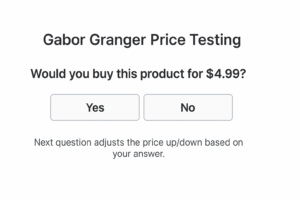
Respondents encounter a price and answer a direct purchase-intention question, such as:
“Would you buy this product for $4.99?”
The question is usually binary: yes or no. Rather than asking respondents to specify a price themselves, the researcher tests their acceptance of particular prices.
This makes the task relatively simple, although the meaning of a yes response depends on the hypothetical purchasing situation presented.
3. Branching Logic
In a common adaptive version of Gabor-Granger, subsequent prices depend on earlier responses. If a respondent accepts the presented price, the next question offers a higher price. If the respondent rejects it, the next question offers a lower price.
The process narrows the range of prices that the respondent appears willing to accept. The tested prices, number of questions, and stopping rules are established in the research design.
Not every implementation uses the same branching algorithm. Some test a predetermined series of prices, while others adapt the sequence to reduce the number of questions.
4. Threshold Identification
The sequence is used to estimate the respondent’s maximum acceptable price within the tested range and subject to the survey’s assumptions.
A respondent who accepts $5 but rejects $6, for example, provides evidence that their stated willingness-to-pay threshold lies somewhere between those values, assuming their responses are consistent. Researchers aggregate these responses to estimate how purchase acceptance changes with price.
The resulting relationship forms the basis for the method’s analytical outputs.
Key Outputs of Gabor-Granger Analysis
Gabor-Granger typically produces a demand curve, a revenue curve, and an estimated revenue-maximizing price. These outputs are related, but each involves an additional level of interpretation.
Demand Curve
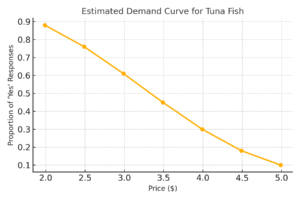
The estimated demand curve shows the proportion of respondents expected to accept a product at different prices. As price increases, purchase acceptance will generally decline.
Researchers use the observed responses or estimated willingness-to-pay thresholds to construct a relationship between price and stated purchase interest. Depending on the design, estimates may require interpolation, smoothing, weighting, or assumptions about responses at prices not directly tested.
The resulting curve is often labeled a demand curve, although it is more precisely a survey-derived purchase-acceptance curve until its relationship with actual market demand has been established.
Revenue Curve
A revenue curve is calculated by multiplying each tested price by the estimated quantity purchased at that price.
When results are expressed as the percentage of respondents accepting each price, multiplying price by that percentage creates a relative revenue index. If researchers have a defensible estimate of the relevant market size and actual purchase probabilities, they can extend the calculation to projected revenue.
The mathematical calculation is straightforward. Its usefulness as a business forecast depends on the quality and interpretation of the underlying demand estimates.
Estimated Revenue-Maximizing Price
The price associated with the highest point on the revenue curve is commonly presented as the optimal price.
More specifically, it is the price that maximizes estimated revenue under the assumptions used to construct that curve, within the range of prices considered. This can be a useful analytical reference.
Whether the estimated price maximizes actual revenue or produces the most attractive business outcome is a separate question.
Price Elasticity
Gabor-Granger results can also be used to estimate price sensitivity or elasticity from changes in the estimated demand curve.
Elasticity describes the percentage change in demand associated with a percentage change in price. These estimates depend on the shape and reliability of the estimated demand relationship.
They should not automatically be interpreted as real-world market elasticities simply because they can be calculated from survey responses.
Common Applications of Gabor-Granger
Gabor-Granger is used in pricing research when organizations want to understand how stated purchase acceptance changes across a range of possible prices.
Testing Prices for Established Products
For products customers already recognize, Gabor-Granger can provide a straightforward assessment of purchase intentions at different prices.
Respondents may have sufficient category experience to make the pricing questions meaningful, particularly when the proposed changes fall within a familiar range. Even in established categories, however, responses may depend on competitors, promotions, purchase occasions, and other conditions not represented in the survey.
Evaluating New Product Pricing
Researchers also use Gabor-Granger during product development to explore acceptable price ranges for proposed offerings.
This can help establish initial expectations about price sensitivity, especially when combined with concept testing or other exploratory research. The results may be less reliable when respondents lack the experience needed to evaluate the offering or have no established reference price.
Exploring Price Sensitivity
The method can identify differences in stated purchase acceptance across price points or respondent groups.
Researchers may compare price sensitivity among customer segments, markets, or product concepts. These comparisons can be informative, provided differences in respondents’ answers are interpreted in the context of the survey design rather than automatically treated as differences in actual purchasing behavior.
Supporting Preliminary Pricing Discussions
Because its outputs are relatively easy to communicate, Gabor-Granger can support early discussions about possible price ranges and the consequences of increasing or decreasing prices.
For decisions that require accurate estimates of switching, competitive response, or financial outcomes, additional evidence may be necessary.
Advantages of Gabor-Granger
The method has several practical advantages that help explain its continued use.
Simplicity. Respondents answer familiar yes-or-no questions instead of completing more complicated allocation or comparison exercises. The task is relatively easy to understand and can be administered in a conventional survey.
Efficient administration. Adaptive questioning can limit the number of prices each respondent needs to evaluate. For a single fixed product, the research design and subsequent analysis can be relatively straightforward.
Direct price sensitivity measurement. Gabor-Granger asks explicitly about purchasing at different prices. This produces a clear record of stated price acceptance rather than relying solely on general importance ratings or abstract price perceptions.
Understandable outputs. Demand and revenue curves are familiar concepts to business audiences. Their visual simplicity can make pricing discussions more accessible, especially when the research is exploratory.
These are genuine advantages. The important issue is not whether Gabor-Granger produces useful measurements, but whether those measurements are sufficient for the decisions being made.
Limitations of Gabor-Granger
The central limitations arise from the structure of the survey task and the assumptions required to interpret the results as market behavior.
1. Limited Competitive Context
The most consequential limitation is that conventional Gabor-Granger studies evaluate a product at different prices without presenting the competing products, brands, and alternatives that customers may encounter when purchasing.
Consider a customer who says they would buy a particular brand of tuna for $4.99. That answer does not establish what happens when a competing brand costs $3.99, a larger package offers better value, or the customer can choose a different protein altogether. Price sensitivity does not exist independently of alternatives. The attractiveness of a product at a particular price depends partly on what else customers can purchase and the tradeoffs those options create.
For pricing decisions involving competition, substitution, or product portfolios, this missing choice context can be more consequential than the technical details of the price-testing procedure.
2. Hypothetical Purchase Intent Is Not Actual Purchasing Behavior
Respondents do not generally spend money when answering a Gabor-Granger survey. They are describing what they believe they would do under hypothetical conditions.
A stated willingness to buy may be informative, but it is not equivalent to a purchase. Real transactions involve financial consequences, immediate needs, available alternatives, and circumstances that may differ from those imagined during a survey. The resulting demand curve therefore requires care in interpretation.
Translating stated acceptance into actual demand involves assumptions about how respondents’ answers relate to behavior.
3. Sequential Questions Differ From Natural Purchase Decisions
Gabor-Granger commonly asks respondents to reconsider the same product repeatedly as its price changes.
Ordinary purchasing situations rarely work this way. Customers typically encounter an offering at a prevailing price, compare it with available alternatives, and decide what to do. Repeatedly asking whether the same product would be purchased at higher or lower prices may influence how respondents interpret the task. It can also make the research process itself more prominent than the purchase decision being studied.
This difference does not automatically invalidate the exercise, but it limits how directly the responses represent natural purchasing behavior.
4. Anchoring and Strategic Responses
The initial price and subsequent sequence may influence respondents’ judgments.
A high starting price can establish a different reference point than a low starting price, potentially affecting how later prices are evaluated. The branching pattern can also become apparent to respondents. If someone recognizes that rejecting a price leads to a lower offer, the structure creates an opportunity for strategic responding.
That does not demonstrate that respondents routinely manipulate the exercise. It identifies a potential response mechanism that should be considered when evaluating the design and interpreting the results.
5. Simplicity Can Be Mistaken for Sufficient Evidence
Gabor-Granger can be attractive when research budgets, schedules, or available expertise are limited.
Lower implementation costs can be a legitimate consideration, particularly for exploratory questions. The difficulty arises when a method is selected for convenience without examining whether its outputs can support the intended decision. A study can be competently designed, efficiently executed, and clearly reported while still leaving important questions unanswered.
Can Gabor-Granger Identify an Optimal Price?
Gabor-Granger can identify the price that maximizes revenue calculated from its estimated purchase-acceptance curve. That is a legitimate mathematical result.
The more important question is whether the curve represents the market response relevant to the pricing decision. In a conventional Gabor-Granger task, respondents evaluate one offering at a series of hypothetical prices. They generally do not choose among the actual competitive alternatives that would influence purchasing behavior. Consequently, the estimated revenue maximum may reflect the survey’s assumptions more than the economic relationships operating in the marketplace.
For a pricing decision, the relevant questions may include how customers switch between brands, how competitors’ prices affect demand, whether customers leave the category, and how different price points influence sales across a portfolio. These relationships are not established simply by finding the maximum of a survey-derived revenue curve.
There is also a distinction between maximizing revenue and maximizing profit. A higher-revenue price may not produce the highest contribution after accounting for costs. But that is secondary to the more fundamental question: whether the demand estimates are credible for the market decision. A researcher can construct a price recommendation from Gabor-Granger results, and additional evidence may improve that recommendation. What the method does not automatically establish is that the recommended price will produce the predicted market outcome.
The point is not that Gabor-Granger has no legitimate use. Its purchase-acceptance measurements can inform pricing research. The question is whether the evidence represents the decisions customers actually face and supports the financial conclusions drawn from it.
You need a method that ties to the income statement, not just survey charts.
Understanding What Gabor-Granger Can and Cannot Establish
Gabor-Granger remains a practical research tool for investigating stated price acceptance.
Its simple survey structure, direct questions, and familiar analytical outputs explain much of its appeal. Used appropriately, it can provide exploratory evidence about price sensitivity and help identify questions that deserve further investigation. But its demand and revenue curves should be interpreted in light of the hypothetical task that produced them.
The broader principle is that research design should follow the business decision. At Red Analytics, this principle is formalized through Strategic Decision Architecture, which connects decision objectives, evidence requirements, research design, and analytical execution. The appropriate interpretation of Gabor-Granger depends on what the research is expected to establish.
Understanding stated purchase acceptance is one objective. Predicting competitive market behavior and financial consequences is another.
Further Reading and Downloadable Guide
The downloadable guide provides a shorter summary of the method and its limitations. It is an earlier companion resource to this expanded explanation.

Jake Lee
Founder, Red Analytics
Jake specializes in choice modeling and advanced marketing analytics. His consulting and methodological research focus on experimental design, statistical modeling, and the evidence needed to support consequential business decisions.
Research & Presentations | Google Scholar